The Untamed: a beginner's map to the drama that broke the internet twice
Before you watch fifty episodes of sword-wielding immortals solving a decade-old murder, here's what a Chinese viewer already knows walking in — and why the show became a global phenomenon anyway.
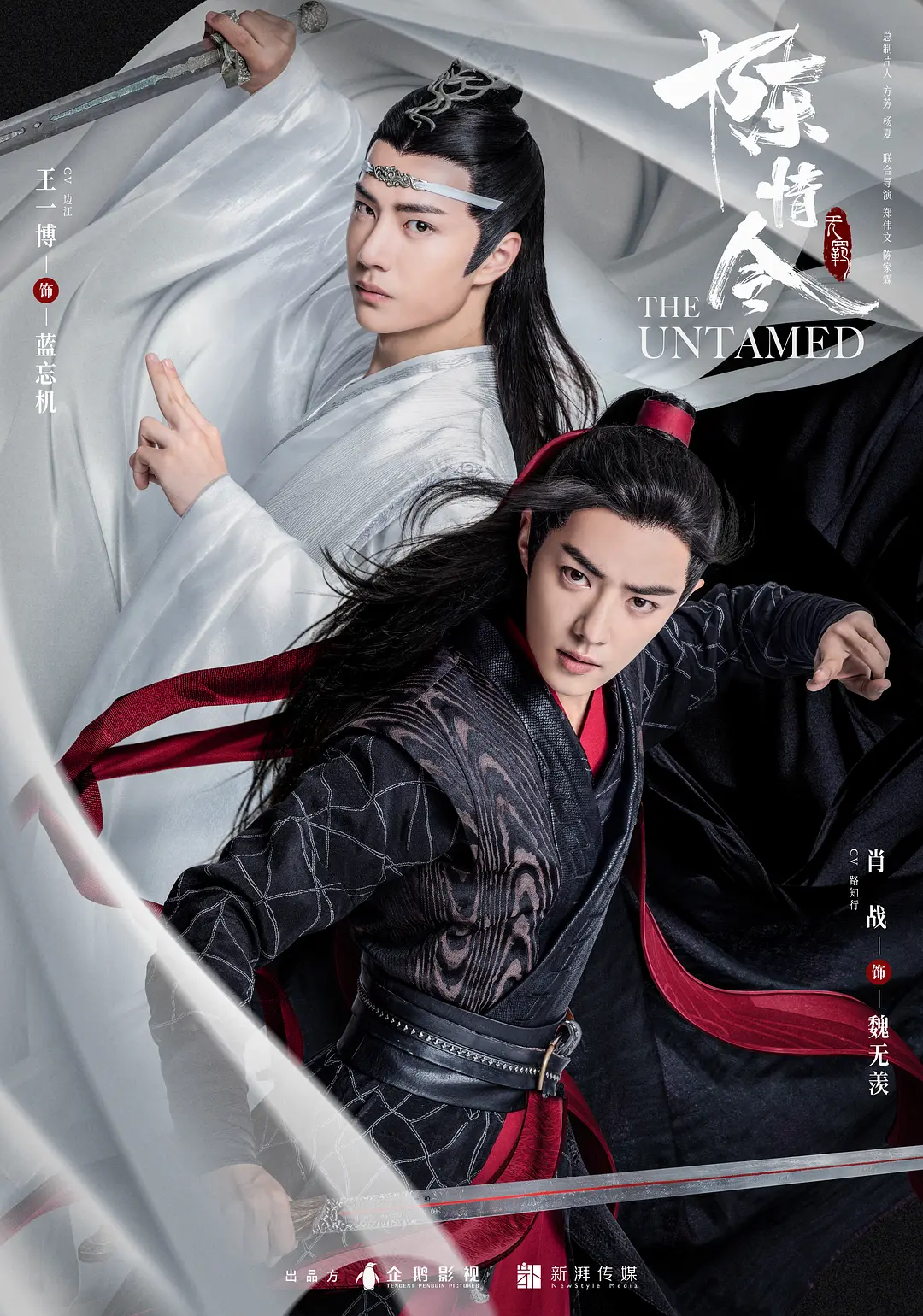
XIANXIA · FANTASY ROMANCE
2019 · Tencent Video · 50 episodes · Based on the novel Mo Dao Zu Shi by Mo Xiang Tong Xiu
Why this one
If you only ever watch one Chinese fantasy drama, overseas fandom has more or less already decided it should be this one. The Untamed is not the biggest-budget xianxia production, nor the most faithful adaptation of its source novel — but it is the one that travelled. Clips of it have circulated on Western fan Twitter for years after it aired; it remains a reliable answer whenever someone asks "where do I start with C-drama."
Part of that is the story itself, which reads as unusually complete even out of cultural context: a wrongly-vilified hero, a stoic love interest who never stopped believing in him, and a mystery that takes sixteen years to fully unravel. But part of it is also what the show represents domestically — the biggest mainstream drama built around a same-sex-coded relationship at a moment when that subject matter had to be handled through implication rather than statement, which is its own story worth knowing before you watch.
The world you're walking into
The setting is a version of ancient China where cultivation — a martial and spiritual discipline that lets practitioners fight demons, wield energy, and pursue immortality — is organized around great clans, each with its own home mountain, teaching style, and reputation. Five clans anchor the story: the disciplined Lan, the fierce Wen, the loyal Jiang, the proud Jin, and the blunt Nie.
注 Xianxia (仙侠): literally "immortal heroes" — a genre distinct from wuxia (martial-arts drama grounded in the real world). Xianxia adds magic, spirits, and the pursuit of godhood on top of the swordplay. If wuxia is Robin Hood, xianxia is Robin Hood who can also throw fireballs.
Wei Wuxian, raised outside the clan system as an orphan taken in by the Jiang family, grows into its most gifted and least conventional cultivator — until a war against the tyrannical Wen clan pushes him toward a forbidden style of cultivation that everyone else fears. Lan Wangji, the second son of the strict, rule-bound Lan clan, is the one person who keeps choosing to trust him anyway, at real cost to his own standing. The show tells their story on two timelines at once: sixteen years ago, when the choices were made, and the present, where Wei Wuxian has been brought back from the dead and has to live with what those choices cost.
"A drama that spends fifty episodes proving a maligned man was right all along — and asks you to sit with how long it took everyone else to admit it."
What a Chinese viewer isn't thinking about, that you might be
注 Danmei (耴美): a literary genre centered on romantic relationships between men, historically read and written mostly by women, and distinct from Western "yaoi/BL" only in its specific publishing history and legal grey zone in China. The novel this show is based on is danmei; the drama adaptation, made for broadcast television, recodes the central relationship as intense devotion and loyalty rather than explicit romance.
This is worth knowing upfront because it changes how you read certain scenes. Where the novel is direct, the drama relies on staging, music cues, and repeated visual motifs — a shared cup, a specific melody, the way two characters are framed in a doorway — to carry weight that dialogue doesn't state outright. Overseas viewers sometimes describe this as "subtext"; it's more accurate to call it a workaround, and part of the show's craft is how eloquent that workaround turned out to be.
The other thing worth flagging: the actors' fame. Xiao Zhan and Wang Yibo were rising idols before this show, and became two of the biggest stars in China because of it. That off-screen trajectory — and the intensity of the fandom that followed both of them individually — is itself part of the show's cultural footprint, even if it's a separate story from the drama on screen.
Cast and crew worth knowing
-
Xiao Zhan as Wei Wuxian
-
Wang Yibo as Lan Wangji
-
Directed by Zheng Weiwen & Chen Jialin
-
Novel by Mo Xiang Tong Xiu
Both leads came from music/idol backgrounds — Xiao Zhan from the group X NINE, Wang Yibo from UNIQ — rather than from acting schools, which is a fairly common pipeline into Chinese television and worth keeping in mind if their line delivery reads as theatrical in early episodes; both loosen up considerably as the season goes on.
Where to watch
-
YouTube — official channel, English subtitles (free, some regions blocked)
-
Viki — English subtitles, subscription tiers
-
WeTV — English subtitles, includes extended Special Edition cut
-
Netflix — availability varies by region
Its echo outside China
By the show's own two-year anniversary, WeTV alone reported more than ten billion streams on the series. That number is a domestic-and-diaspora figure more than a purely "Western fandom" one, but it points at the same thing overseas discourse independently arrived at: this was never a niche watch. It picked up dubbing efforts (a full Japanese dub was announced for its anniversary), spawned two spin-off web films, and remains one of the most-cited entry points in English-language C-drama fan spaces years after it aired — the drama equivalent of a gateway show.
If you're building a mental map of Chinese television for the first time, that's the honest way to place it: not as the most representative Chinese drama, but as the one that proved a Chinese drama could travel this far, and taught a whole cohort of overseas viewers what to look for next.
Want to talk about this? Join the conversation on our Discord →