The Journey of Flower: the 2015 hit that turned a xianxia novel into a 20-billion-view franchise
Master-disciple forbidden love, a demon god, and a heroine who ends up carrying the world's power in her own body — the 2015 Hunan TV drama that became the first Chinese series past 20 billion online views.
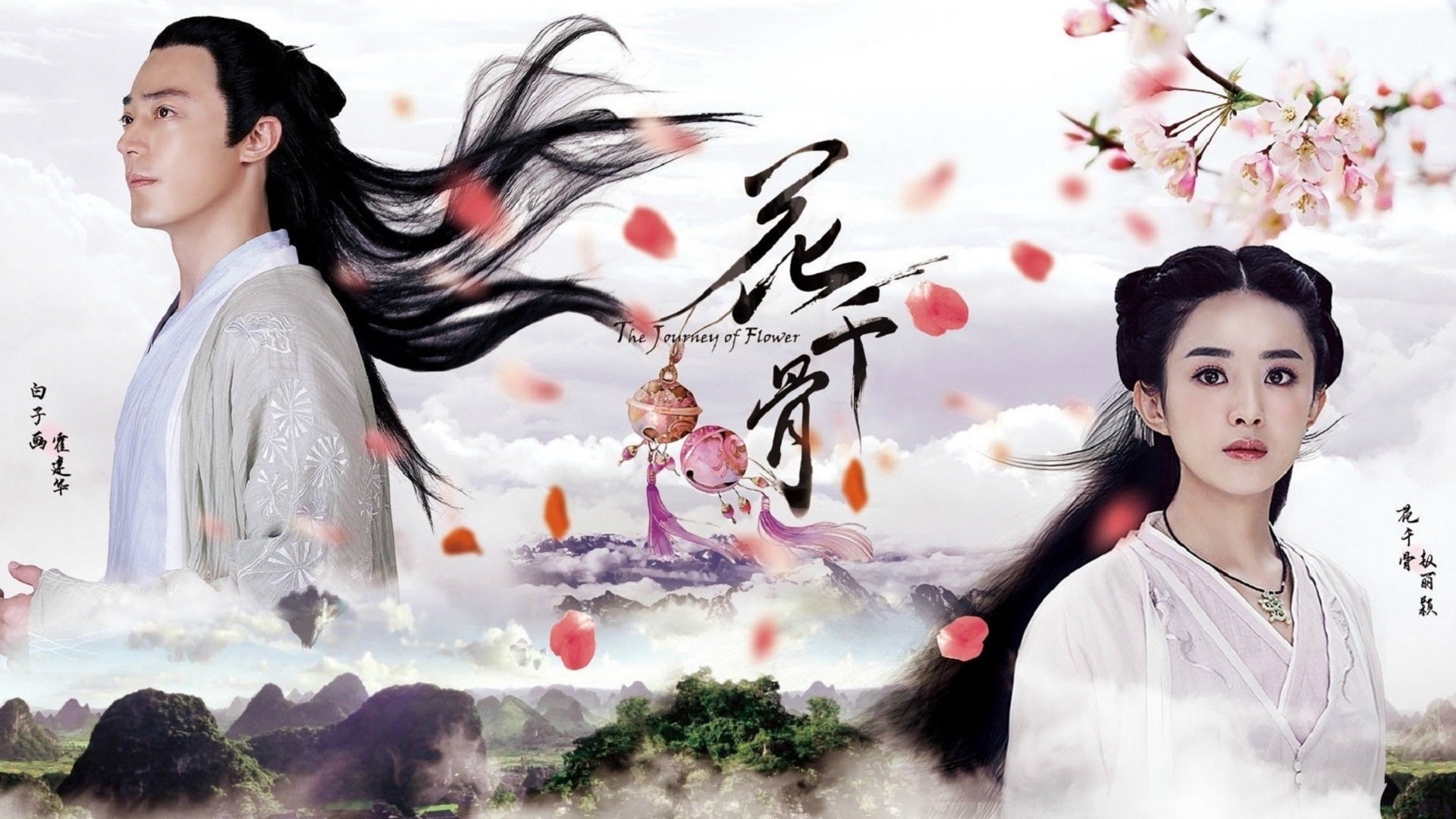
2015 · Hunan TV · Zhao Liying (赵丽颖), Wallace Huo (霍建华)
Why this one
If you want to understand how xianxia (仙侠, "immortal heroes") became a mainstream television genre rather than a web-novel niche, The Journey of Flower (花千骨, Hua Qiangu) is the case study. It aired on Hunan TV from June 9 to September 7, 2015, and it was one of that year's highest-rated dramas. It also became the first Chinese series reported to pass 20 billion online views, at a time when that number said as much about streaming-platform economics as about audience taste. It won Drama of the Year from iQiyi, and Zhao Liying (赵丽颖) won Best Actress at the Macau International Television Festival for the title role.
The commercial afterlife matters as much as the ratings. A licensed mobile game reportedly earned 200 million yuan in its first two months. That is the template later xianxia hits were built to imitate: a web-novel IP, a TV show, and a game, all released as one coordinated product rather than three separate ones.
The setup
Hua Qiangu is an orphan who carries a scent that attracts demons, which has made her an outcast since childhood. She is rescued by Bai Zihua (白子画), the leader of the Chang Liu (长留) sect and one of the most revered immortals in the world. He has, in fact, been tasked with killing her, and he spares her instead. She becomes his disciple on Mount Chang Liu, and she falls in love with him.
That is where the story turns from a romance into a tragedy about consequences. To save Bai Zihua's life, Hua Qiangu sets out to retrieve ten ancient artifacts, and in doing so she inadvertently revives the Demon God. The show reveals that she is the last descendant of the goddess Nüwa (女娲), which is why she is the only one who can contain that power: she takes the Demon God's power into herself. The drama keeps going past the point where a lighter romance would have stopped. She pays for the peace she buys with her own life, another character trades his own life to bring her back, and Bai Zihua leaves the sect to look after her.
Note — The master-disciple romance (shitu lian, 师徒恋): A teacher and a student falling in love is one of the most reliable forbidden-love setups in Chinese web fiction, and xianxia is where it lives most comfortably. The sect, the vows, and the hierarchy are the built-in obstacle, so the writers don't need to invent an outside villain to keep the couple apart. The Journey of Flower takes that convention and raises the stakes: the disciple Bai Zihua falls for is the same person he was ordered to kill, and the person the story frames as the great tribulation of his life.
What the show is actually about
Strip away the fantasy vocabulary and this is a story about proof of devotion. Almost every major plot movement is a version of the same question: how much will one person give up for another, and does the other person have the right to accept it? Hua Qiangu spends the second half of the series giving things up (her freedom, her safety, eventually her life) and the show keeps returning to how little the people she is saving are able to do with that gift.
That design choice is also the natural place for a viewer to disagree with the show. You can read it as devotion at its most extreme, or as a heroine defined largely by what she endures. Both readings come from the same structure, and it is worth watching with the question in mind rather than expecting the show to settle it.
Cast and crew worth knowing
-
Zhao Liying (赵丽颖) as Hua Qiangu, the role that moved her into the top tier of Chinese TV leads. She also anchors two other titles on this site, The Story of Minglan and The Legend of Shen Li.
-
Wallace Huo (霍建华) as Bai Zihua, the emotionally restrained sect leader.
-
Based on the novel Hua Qiangu by Fresh Guoguo (fresh果果), which drew on Daoist immortality legends.
-
58 episodes on TV (the DVD release runs 50), broadcast two per night on Hunan TV.
Where to watch
Availability varies by region and has changed over the years; check the current listings for your country (English subtitle support is not consistent across platforms).
Its echo outside China
The show is less visible in English-language fandom than The Untamed or Eternal Love, even though it came first. Part of that is timing: in 2015 there was no large English-subtitling ecosystem for Chinese dramas, and the fan-translation pipelines that later made overseas hits possible were still forming. The domestic record is very different from the overseas reputation, which is a useful reminder that when a show became famous in English tells you when the subtitling infrastructure arrived, not when the show mattered.
Want to talk about this? Join the conversation on our Discord →