Warriors, Consorts, Survivors: The Ancient Women Behind Every C-Drama Heroine
Seven women, one recurring trap in how their stories get told — and one who broke it completely. From Hua Mulan and Daji to a Qing-dynasty pirate queen the Qing navy couldn't defeat.
For readers new to C-drama, the palace-intrigue heroine — the woman who out-maneuvers, out-lasts, and occasionally outlives everyone around her — can look like a modern invention, sharpened for streaming-era pacing. It isn't. A recent South China Morning Post feature on women in Chinese folklore anchors the idea in two figures, Hua Mulan and Daji, and its own framing captures it in one line: these women "trade personal autonomy for survival in a man's world." Widen the lens across the rest of Chinese history — SCMP runs an occasional series on notable women that covers several more of them — and the pattern holds up again and again: a warrior, a scapegoat twice over, an empress who ruled from behind actual silk curtains and one who never needed to rule from anywhere visible at all. It also, once, breaks completely — which turns out to be the most useful data point of all.
Hua Mulan (花木兰): the filial warrior
The oldest and most famous of the figures here is Hua Mulan (花木兰), whose story comes from the Ballad of Mulan, a 332-character folk poem dated to the Northern Wei dynasty (386–535 CE) — more than a thousand years before any of it reached a screen. In the poem, Mulan disguises herself as a man to take her aging father's place in the army, serves for over a decade without her unit ever suspecting her sex, and afterward turns down an official post to go home instead.
It's worth separating the poem from the version most overseas audiences know. Disney's two Mulan films (1998 animated, 2020 live-action) reframed the story as an individual coming-of-age arc — a girl discovering her own strength and eventually being celebrated for who she really is. The original ballad isn't really about that: Mulan's stated motive is filial, not personal, and the poem's own emphasis falls on her twelve years of undetected competence, not on self-discovery or public recognition. China's own big-budget take, 2009's Mulan: Rise of a Warrior, cast Zhao Wei (赵薇) in the role over Zhang Ziyi (章子怡) and Michelle Yeoh (杨紫琼), and over Liu Yifei (刘亦菲) — the actress Disney would cast eleven years later — and played the story straighter: a war film about what the twelve years of concealment actually cost her.
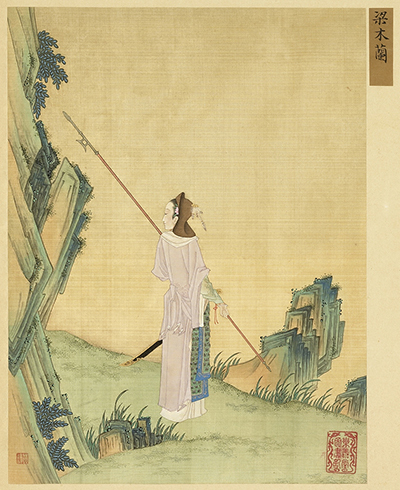
畫麗珠萃秀 ("Gathering Gems of Beauty"), a Qing-dynasty painting depicting Hua Mulan (花木兰).
Erased twice over: Daji (妲己) and Consort Wan
The clearest version of the "villainess" archetype is Daji (妲己), a consort associated with King Zhou, the last ruler of the Shang dynasty, best known from the 16th-century novel Investiture of the Gods (Fengshen Yanyi). In the folklore tradition she's blamed — the SCMP piece calls her "one of the most famous women in Chinese folklore" — for manipulating the king into three decades of cruelty and excess until the dynasty collapsed. The novel makes the erasure literal, not just narrative: a thousand-year-old fox spirit, sent by the goddess Nuwa (女娲) to punish the king's arrogance, kills the real, human Su Daji (苏妲己) and takes her face to enter the palace. The "Daji" who seduces and corrupts the king for the rest of the story isn't the woman at all — she's a monster wearing a murdered woman's identity, carrying out a goddess's plan. The role has stayed castable regardless: Fan Bingbing (范冰冰) played Daji in the 2016 film League of Gods, and the character returned as a central figure in the recent Creation of the Gods trilogy.
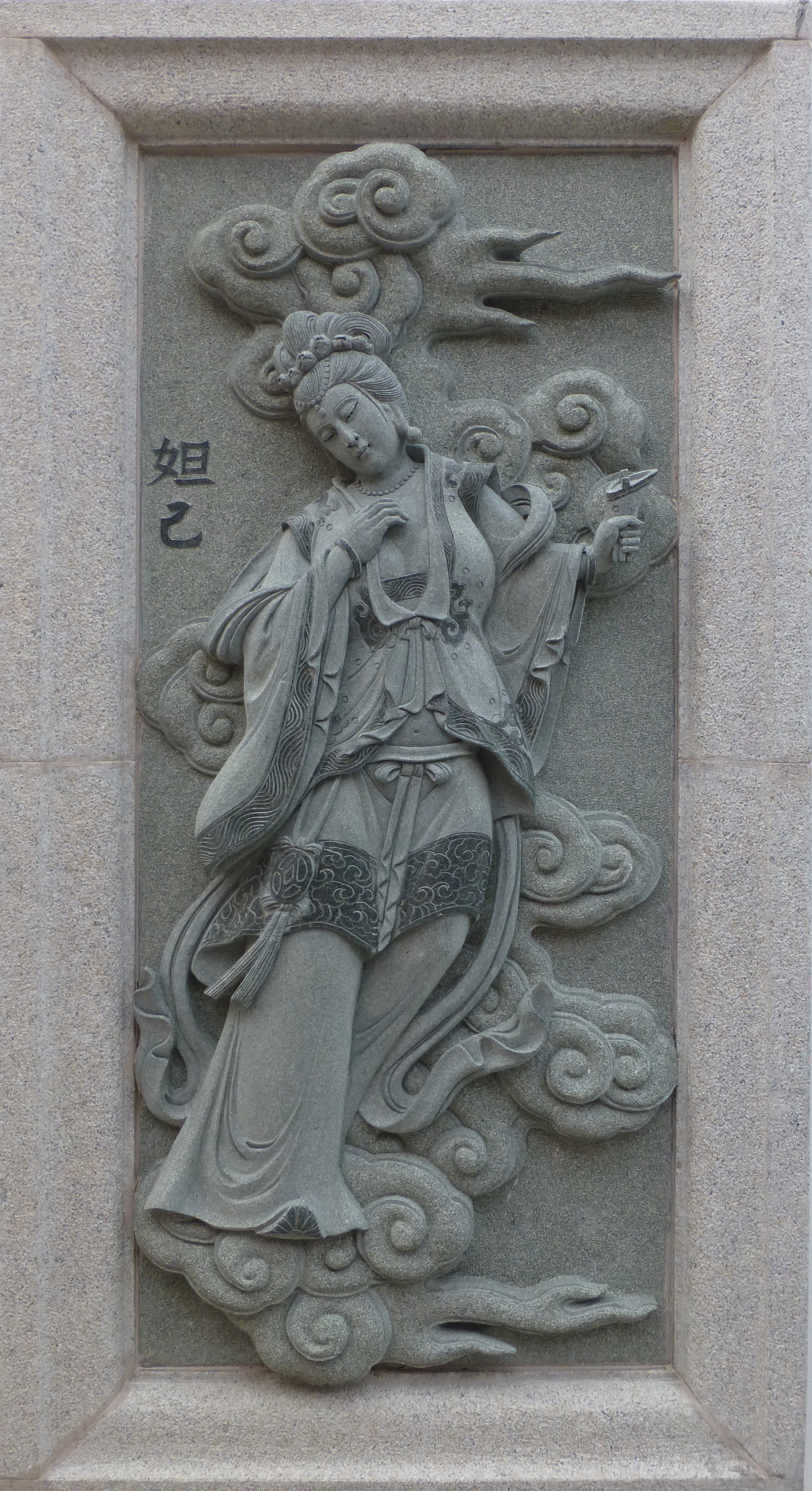
A traditional temple relief depicting Daji (妲己), from a series on the Investiture of the Gods.
A documented version of the same pattern shows up almost two thousand years later, with a real woman instead of a fox spirit. Consort Wan (万贵妃), born Wan Zhen'er (万贞儿), was seventeen years older than the Ming dynasty's Chenghua Emperor — she had been his caretaker as a child before becoming, and remaining, his sole favored consort for the entirety of his 23-year reign. The official History of Ming accuses her of persecuting rival consorts and suppressing the emperor's fertility to protect her position — except the same emperor fathered fourteen sons and six daughters, a record that doesn't square with the accusation. Like Daji, Consort Wan's reputation was built by court historians writing after the fact, for an audience that apparently needed an explanation for a powerful man's choices that didn't involve crediting the woman he actually chose.
Two rulers, two strategies: Wu Zetian (武则天) and Empress Dowager Xiaozhuang
Wu Zetian (武则天, 624–705 CE) took the most direct route available to a woman in imperial China: she became emperor. She entered the palace as a low-ranking concubine of Emperor Taizong (唐太宗), was sent to a Buddhist nunnery after his death per custom for childless consorts, and was recalled by his son and successor, Emperor Gaozong (唐高宗), who made her his empress. After Gaozong's death she ruled through her sons before declaring herself emperor of a new dynasty in 690 — the only woman in Chinese history to hold the title in her own name. The most notorious episode in her rise, the death of her infant daughter in 654, is genuinely contested: the traditional account, compiled generations later by the Confucian court historians of the dynasty that succeeded her, claims Wu smothered the baby to frame a rival consort, but the story doesn't appear in the earliest surviving records, and many historians now treat it as more likely to be later political slander than a documented act.

A detail from 唐后行従图 ("The Procession of a Tang Empress"), depicting Wu Zetian (武则天).
Empress Dowager Xiaozhuang (孝庄文皇后, 1613–1688) took the opposite route to comparable influence. Born a Mongol noblewoman of the Khorchin clan, she advised three consecutive rulers — her husband Hong Taiji, her son the Shunzhi Emperor, and her grandson the future Kangxi Emperor, whom she helped steer safely past a powerful regent in his minority — without ever ruling in her own name or, unlike the empress dowager who came after her, ever formally presiding over the court herself. Popular culture has mostly preferred a version of her with a name she never actually had: 大玉儿 ("Big Jade"), a Republican-era invention from folk fiction and later television drama, built around a romance with the regent 多尔衮 that isn't documented history. It's a small, telling echo of this site's other coverage of costume-drama history: the more interesting real story — three generations of competent influence, deliberately kept out of the spotlight — apparently needed an invented love story before television found it interesting.

A Qing court portrait of Empress Dowager Xiaozhuang, painted late in her life.
Two empresses blamed for an empire's end: Yang Guifei and Cixi (慈禧)
Yang Guifei (杨贵妃, 719–756 CE) was the most favored consort of Emperor Xuanzong (唐玄宗) during the peak years of the Tang dynasty — and, before that, briefly married to Xuanzong's own son, a scandal the histories don't gloss over. Traditional narratives hold her responsible for distracting the emperor from statecraft and for the rise of her adopted kinsman An Lushan (安禄山), whose rebellion in 755 is widely treated as the moment the Tang dynasty's long decline began. When Xuanzong's own imperial guard mutinied during his flight from the rebellion, they refused to keep protecting him unless Yang Guifei was killed; she was strangled at Mawei Slope, at the emperor's own order, to save himself. She's remembered at least as much for Bai Juyi's (白居易) Song of Everlasting Sorrow, the poem that turned her death into one of Chinese literature's most famous tragic romances, as for the rebellion she's blamed for.
Empress Dowager Cixi (慈禧, 1835–1908) is a harder case, precisely because the power she held wasn't symbolic. After a coup following the Xianfeng Emperor's death in 1861, she ruled from behind a literal curtain — 垂帘听政, "attending to court affairs from behind a screen," the constitutional workaround that let an empress dowager exercise power she wasn't formally supposed to hold — for close to half a century across two child emperors' reigns. Standard historical judgment holds her substantially responsible for the empire's failure to modernize and its eventual collapse, and unlike Yang Guifei, that judgment isn't pure scapegoating: she really did prioritize her own position over reform at more than one critical moment. But even that harsher, more deserved verdict still tends to flatten a genuinely mixed record — a ruler who did push some real modernization efforts, undone as much by the scale of the crisis she inherited as by any single decision of her own — into the same simple shape as everyone else in this piece: a woman with power, and a national catastrophe blamed on her having it.

Empress Dowager Cixi (慈禧), photographed around 1903–1904 by the court photographer Xunling — no comparable portrait of Yang Guifei survives; every existing image of her is a later artistic recreation.
The one who didn't trade anything: Zheng Yi Sao
Every figure so far fits roughly the same shape: gain influence, then lose your personhood to the story (Daji), your reputation to biased chroniclers (Consort Wan), your legitimacy to a hostile historiography (Wu Zetian), your documented career to an invented romance (Xiaozhuang), your life to someone else's crisis (Yang Guifei), or your legacy to a verdict that's at least partly fair but still oversimplified (Cixi). Zheng Yi Sao (郑一嫂, 1775–1844) doesn't fit it at all, and that's what makes her useful to end on.
She began as a sex worker on a Guangdong flower boat, was taken by the pirate Zheng Yi, and after his death in a 1807 typhoon, inherited outright command of the Red Flag Fleet — by some counts the largest pirate confederation in history, numerous enough to hold its own against the Qing navy and against British and Portuguese warships. She didn't rule through anyone else's authority or survive by staying hidden; she ran the fleet on a published code of conduct — looted goods pooled and split by fixed percentage, captured women protected from assault on pain of death — strict enough that the Qing government, unable to defeat her, negotiated instead. In 1810, at thirty-five, she came to Guangzhou and struck her own amnesty deal with the governor-general: full pardon, no forfeiture of her fortune, an honorary title, and a comfortable retirement that lasted another thirty-four years, during which she reportedly advised the Qing official Lin Zexu on strategy against the British in the Opium War.

A traditional portrait of Zheng Yi Sao.
Nothing about that story is a trade of autonomy for survival. It's closer to the opposite: autonomy secured by force, then formalized by negotiation, on terms she set herself.
Why the pattern matters
What connects six of these seven women isn't era or genre — myth, documented history, and popular legend are all represented here — it's the shape of the story each gets told in. A woman gains competence, influence, or power, and the narrative erases her gender to let her succeed (Mulan), erases her personhood to explain a catastrophe (Daji), assigns her a scandal that doesn't match the facts (Consort Wan), recasts legitimate rule as illegitimate scheming (Wu Zetian), replaces a documented career with an invented romance (Xiaozhuang), blames her for a catastrophe she didn't cause alone (Yang Guifei), or flattens a genuinely mixed record into a single simpler verdict (Cixi). Zheng Yi Sao is the seventh case precisely because she breaks the pattern — proof that the "trade" was never inevitable, just how the story usually got told for everyone who didn't happen to have an armed fleet of her own.
That's also, unmistakably, the shape of a modern zhaidou (宅斗) or palace drama. A protagonist in Empresses in the Palace (甄嬛传) or Story of Yanxi Palace (延禧攻略) spends a season navigating exactly the trap most of these women were written into — except now the camera stays with her, and the show usually lets the audience see the trap as a trap, rather than as evidence she deserved what she got. That reframing, more than the palace setting or the costumes, is what separates a modern C-drama heroine from the women she's descended from — and it's worth remembering that at least one of them never needed the reframing in the first place.
*Sources: South China Morning Post, SCMP — Consort Wan, *SCMP — Wu Zetian
Want to talk about this? Join the conversation on our Discord →